It’s a wonderful thing when one of the fastest-growing tech-related career fields is accessible to you – even if you don’t hold a tech-related degree. In fact, having a liberal arts, humanities, or social and behavioral science background actually makes you a better fit for the Human-Centered Interaction Design (HCID) field than the techies!
We believe technology is ultimately about people. The most important design challenges today are rarely technical. They are human: understanding communities, navigating organizations, communicating across disciplines, and making thoughtful decisions in conditions of uncertainty.
Human-Centered Interaction Design (HCID) is the practice of designing those technologies, products, services, and experiences so they are useful, usable, ethical, and meaningful for the people they serve.
The Master of Science in HCID prepares students to become researchers, designers, and leaders capable of leading design within complexity.
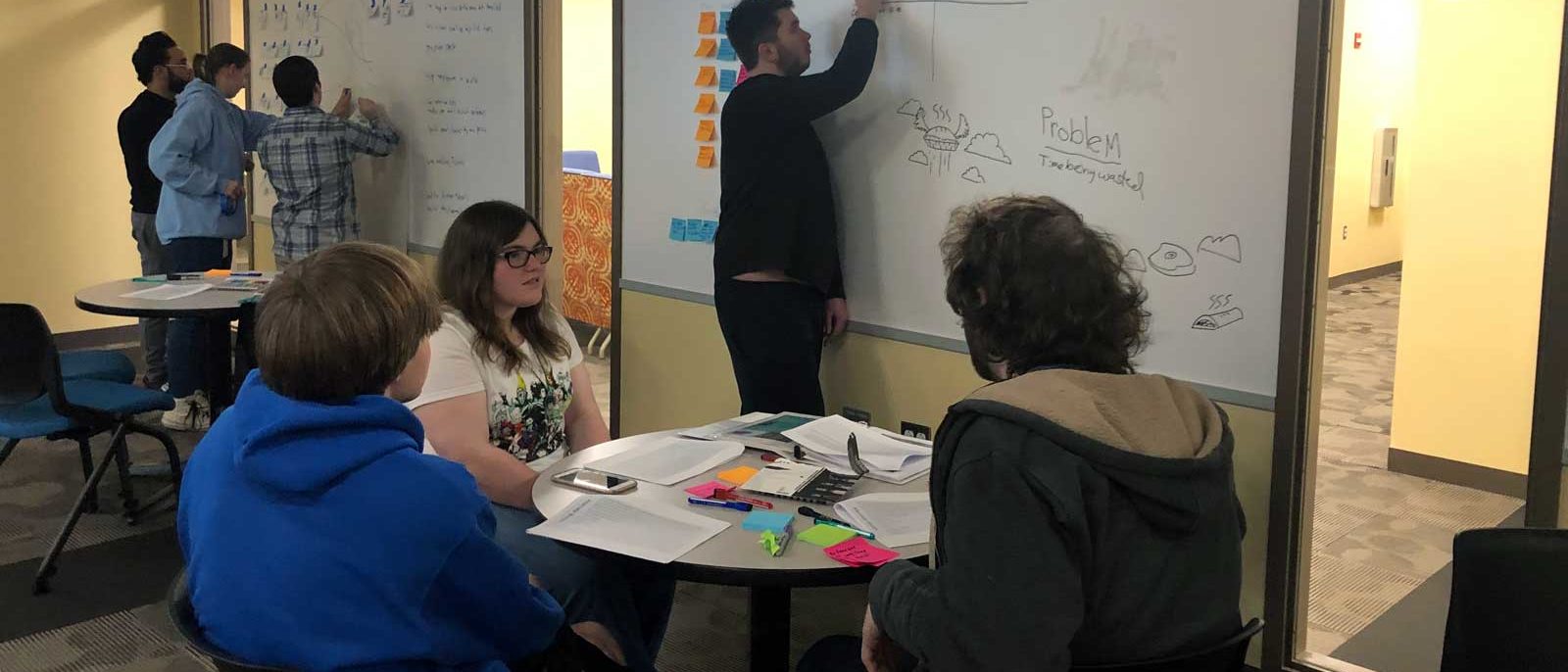
Our students come from architecture, urban planning, education, marketing, graphic and UX design, and a wide range of other fields. Some seek to transition into a field requiring professional design judgment; many seek advancement to leadership positions in their current fields. Students learn alongside classmates with varied experiences, building the collaborative skills needed to lead multidisciplinary and multinational design teams.
Rather than focusing narrowly on particular software tools or design methodologies, the HCID program emphasizes adaptable design judgment—the ability to understand complex human situations, frame meaningful questions, conduct rigorous research, communicate evidence-based design rationale, and make thoughtful decisions in rapidly evolving technological environments. Students learn to design products, services, and experiences while understanding the organizational, cultural, social, and ethical contexts in which those designs operate.
Students develop expertise in research, systems thinking, communication, interaction design, ethical practice, and the thoughtful use of emerging technologies. Graduates work in consulting, healthcare, government, education, finance, technology, nonprofit organizations, and startups as researchers, designers, strategists, and design leaders.
Our Approach
The HCID program approaches design as both a professional practice and a mode of inquiry. Rather than teaching a single design process or prescribing universal methods, the program develops the design judgment needed to adapt thoughtfully to new technologies, organizations, and social contexts.
Our courses are intentionally small, creating an environment where discussion, critique, and collaboration are central to learning. Beyond a shared core, students shape their own paths through electives that reflect their interests and professional goals. More than a collection of courses, HCID is a community of scholars, practitioners, and students committed to understanding—and improving—the relationship between people and technology.
We believe thoughtful design begins with thoughtful questions. Throughout the program, students learn to investigate problems before proposing solutions, using research and critical inquiry to inform every stage of the design process. Students learn by conducting research, critiquing ideas, collaborating across disciplines, and engaging with authentic design problems whose solutions are rarely obvious.
Program Goals
Graduates of the HCID program will be able to:
Frame and address design challenges grounded in human needs, values, and contexts.
Plan, conduct, interpret, and communicate research that informs design decisions.
Create, evaluate, and refine design outcomes using appropriate methods and evidence.
Communicate design processes, rationale, and outcomes through written, visual, and oral forms.
Recognize and address the social, organizational, and ethical implications of design practice.
Industry Highlights
Program Courses
This program requires a total of 36 semester hours: 18 semester hours from the core courses listed below, 6 semester hours of experiential courses, and 12 semester hours of Individualized Concentration courses. The semester hour value of each course appears in parentheses ( ).
This course will introduce the student to the fundamentals of Human-Centered Design, using the Double Diamond Model, which forms the foundation of HCID’s program and process. Current research in disciplines from neuroscience to anthropology is applied to derive design principles which prioritize human needs. The student then applies these principles to identify, research, and analyze human needs in fields of their choice in a guided exploration of the first diamond of the procedural model.
This course will introduce the student to the study design and qualitative research methods employed within human-centered interaction design (HCID). In this process-driven course, the lessons will be structured around design research methodology, execution, and reporting. Through readings, discussions, and the exploration of examples, guidelines, and heuristics, the course engages the student in the ethical and entrepreneurial aspects of human needs and opportunity research within service and product design practice.
Design solutions often require us to confront fundamental ethical issues. Ethical design involves considering the values of all involved parties, such as designers, corporate employers, intended users, and unintended users. Ethical design involves applying values, derived from theory, in every stage of the design process.
In this course, the student will examine a range of ethical theories, from the classical Western canon to feminist and Confucian theories, in order to analyze designs in fields from mobile apps to architecture, from military technologies to financial products, and will examine in depth the ethical challenges of AI. The student will perform in-depth ethical analyses, applying theories of their choice to better understand design decisions in their fields of interest, and will participate actively in weekly discussions, applying ethical theory to existing and future design solutions.
This course will introduce the student to the theories and perspectives of human social behavior that are employed most often in HCID. Drawing on canonical and new sociotechnical science literature, the course will present the student with overviews of theories of information, action, sociality, conflict, and interaction within traditional and digital environments. Through readings and examples, the course includes attention to sociotechnical theories around communities of practice, online communities, social media, and enterprise knowledge management. This seminar course offers the student a better understanding of the contexts and perspectives within which people interact with others, around and through offline, online, and hybrid environments.
This applied overview course focuses on designing and integrating smart technologies into private and public spaces through a human-centered lens. The student will learn about opportunities and challenges with the integration of smart technologies and ambient environments into human life. The student will consider the social impacts and ethical considerations and trade offs when designing intelligent, multisensory human-technology interactions.
Businesses maintain a competitive edge by offering a combination of products and services. How well interactions with a product go for users can determine the success or failure of the product. This course will discuss creating successful product service systems (PSS), and how to create desired outcomes for customers that are also valuable to the business. Service designers are at the forefront of carrying out research to answer these questions. In this course, the student will learn service design frameworks and research methodologies that tackle these service design prompts and usability issues. Class sessions will consist of lectures, discussions, sketching, design thinking exercises, presentations, and critiques. Work will be done individually in the first two assignments and in teams for the final assignment.
This course will introduce the student to the design-based theories and contexts of users and populations, as found in human-centered interaction design. The course will focus on evidence-based advocacy through targeted user research. Through a solid foundation of self-awareness, the student will work in research teams to conduct user discovery, identify design problems, and evaluate existing solutions to ensure inclusive design for their assigned population. The course draws the student’s attention to the need to develop their design eye for contextual integration of user and population theory within design practice.
This course offers the student the opportunity to work with a variety of tools and processes that support design practice. The course exposes the student to traditional and digital tools, templates, and techniques for design. Using an example project supplied by the professor, the course is run as a series of studios. After using tools and processes in each stage of the design process, the student reflects on the suitability and use case for each tool and reflect on their evolving sense of self as a designer. The course covers the tools, processes, and techniques necessary to professionalize the student’s design practice.
This course introduces the student to the contextual design of patterned interfaces in human-centered interaction design. The course is structured as a series of seminars around four design area: contexts; visuals; patterns; and actions. Taking the approach of goal-driven design, the student will engage in reading, discussing, experimenting, and presenting design rationales for design choices around traditional and new digital interfaces. The course builds on what the student learned in the other courses and intensifies the student’s development of their design eye for contextually sensitive interaction design. The student will be challenged to consider areas of conflict and divergence within design thinking. While employing their own evolving capacity for design, the student will learn to manage conflicts between goal orientations, contextual needs, and environmental challenges.
The in-program elective choices may vary each year, depending on needs and abilities of students, faculty, and external clients. Some co-teaching across the university’s technology programs is expected to occur.
This course is a one-on-one student-focused studio in which the student will produce a series of design research data collection and analysis instruments, and upon attainment of IRB approval, conduct a significant project in human-centered design research. The studio culminates in a live pitch session to the HCID full-time faculty as a whole, and a written process report.
This course is a one-on-one student-focused solution design and prototype creation studio. This course requires the student to use the results of their HCID 695 research and recommendations to design, build, test and improve a conceptual prototype that addresses the user needs and design recommendations from HCID 695, drawing on every course taken at HU, to realize their design solution.
Information for
Students who want to come to the U.S.
The University is home to more than 5,000 international students representing 110 countries.